Urgency in an email means telling the reader when something ends. This guide separates what's been shown from what gets repeated without a source, sums up what regulators in the US, the EU and the UK treat as deceptive, and suggests how to use deadlines without losing your list's trust. If your offer has a date, the generator below builds the countdown.
Urgency in email marketing: what works and what crosses the line
In short
A real deadline makes people decide sooner: peer-reviewed studies show it with coupons and promotions, and the UK's CMA acknowledges it. We haven't found any study measuring how much a countdown lifts clicks in email. A fake countdown, one that resets or never ends, is treated as deceptive in the US, the EU and the UK.
Make your own
The generator is already set up for this page. Change what you need and press Create timer.
Live 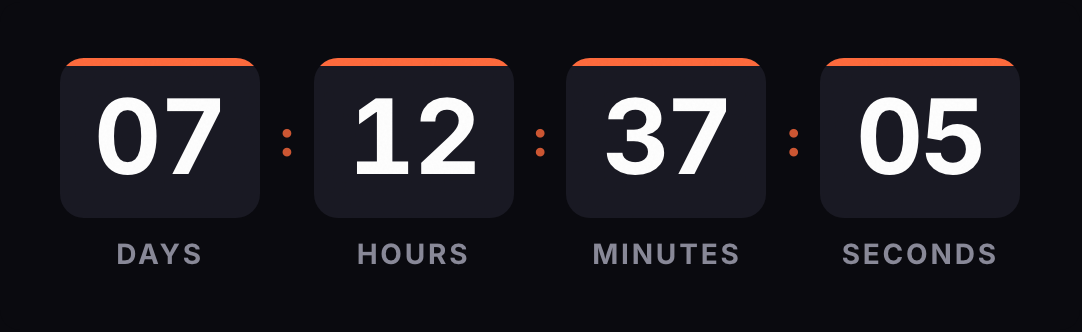
Animated GIF. Recalculated every time the email is opened.
Why does a deadline make people act?
There's peer-reviewed research on this, and nearly all of it is about coupons and promotions, not email:
- Dated coupons. Inman and McAlister (Journal of Marketing Research, 1994) analyzed weekly redemptions of pasta sauce coupons in Nielsen panels from two cities. Redemptions didn't just cluster right after the coupons went out: a second peak showed up just before the expiration date.
- Long deadlines. Shu and Gneezy (Journal of Marketing Research, 2010) found that people who get a gift certificate or gift card with a long deadline put off using it, and end up redeeming less than people with a short one. The participants themselves expected the opposite.
- Short promotions. Aggarwal and Vaidyanathan (Journal of Consumer Behaviour, 2003) found that short promotions pulled purchases forward, while long-running ones didn't.
The UK's Competition and Markets Authority summed it up in its 2022 paper on online choice architecture: there is "considerable evidence" that consumers react to scarcity, and numerous studies find effects on click-through, purchases and perceived value. It adds a point worth keeping in mind: when these claims are true, they help consumers avoid missing something that really is running out and get past procrastination.
In all three studies the effect comes from the date. The 1994 coupon had no animation, just a printed expiration date.
How much does a countdown improve email results?
We don't know, and we haven't found anyone who has published it with a method you can check. We looked for peer-reviewed studies and regulator papers comparing the same email with and without a countdown, and there aren't any.
Figures like "15 to 30 percent more clicks" get passed around. This site's old articles repeated them too. We couldn't trace any of them to an original study, so we removed them.
What you can do is measure it on your own list. We explain how at the end of this guide.
What do regulators treat as deceptive?
A summary of what the official sources say. It isn't legal advice: if you have questions about a specific campaign, talk to a lawyer.
United States
In September 2022 the FTC published the staff report "Bringing Dark Patterns to Light." Among the urgency patterns it describes is the "baseless countdown timer," a fake countdown that goes away or resets when it times out, along with the "false limited time message," which claims an offer is good only for a limited time but has no deadline, or one that just resets.
European Union
The Unfair Commercial Practices Directive has a list of practices banned in all circumstances. Point 7 covers falsely stating that a product will be available only for a very limited time, or on particular terms for a very limited time, to push an immediate decision and deny consumers the chance to make an informed choice. The rule is about the false claim and doesn't mention any channel.
In January 2023, the European Commission and consumer authorities from 23 member states, Norway and Iceland screened 399 online shops. 148 used at least one of the three patterns they were looking for, and 42 had fake countdown timers with deadlines to buy specific products.
United Kingdom
In July 2023 the CMA called on Emma Sleep to change its practices because its countdown clocks risked giving the impression that discounts would soon end and prices would go up, when that often wasn't the case. In July 2024 it closed its Wowcher case: most products stayed at a similar price once the daily countdown ended, and Wowcher committed to removing the misleading timers.
What researchers found
A team from Princeton and the University of Chicago (Mathur and colleagues, 2019) crawled about 11,000 shopping sites. They found 393 countdown timers and confirmed that 157, on 140 sites, were deceptive: they reset after running out, or the offer was still valid afterward.
All of these cases involve websites. Email adds one twist: the reader can reopen the message days later and check whether the deadline was real.
How can you tell if your countdown is honest?
- When it hits zero, the offer ends. The price goes back and the coupon stops working at that time, not the next day.
- If you extend it, you say so. A new email saying "We've extended it to Sunday" is an extension. Quietly resetting the clock is exactly what the FTC and the CMA describe.
- The coupon and the timer expire together. Set the code's expiration in your store to the same date, time and zone as the timer.
- Evergreen means per recipient. For a window that starts with each person (48 hours from signup), use a per-recipient timer and make that person's coupon expire at the same moment. The free evergreen starts over on every open and doesn't mark a real end. In Apple Mail, a per-recipient window may start when the email arrives, because Apple downloads images before it's read.
- Scarcity has to be real too. "Only 3 left" only if there are 3 left.
- "Last chance" goes in the last email. If every send says it, none of them is.
How do you use deadlines without burning out your list?
Save the countdown for emails with a date. If every send carries one, readers learn to ignore it. A newsletter has nothing that expires.
Write the exact date. "Ends Sunday, December 6 at 11:59 p.m. Eastern" informs. A "limited time only" with no date looks a lot like the message the FTC describes as deceptive when there's no real deadline behind it.
Explain why it ends. The end of a season, the day of an event or the size of a production run. A deadline with a reason is easier to believe than a bare one.
Use the same countdown across the sequence. The announcement, the reminder and the last-day email can carry the same timer URL, because the GIF is rendered at open and shows what's left in each one. Our complete guide to email countdown timers explains how.
How do you measure whether urgency works on your list?
- Split the list in two. Same email, same send time. Half get the countdown plus the written date; the other half get only the date.
- Compare clicks and sales, not opens. With Mail Privacy Protection on, Apple downloads the email's content whether or not it's opened. That inflates opens and timer impressions alike.
- Repeat it across several campaigns. A single send depends too much on the offer and the day.
- Watch unsubscribes and complaints. A campaign that sells more but spikes unsubscribes can cost you over time.
If the countdown doesn't move anything for your list and your offers, drop it and keep the written date.
To set it up on your platform, see the guides for Klaviyo, Mailchimp, HubSpot and Shopify Email.
Common questions
Is it illegal to put a countdown timer in an email?
No. What regulators treat as deceptive is falsely claiming something is available only for a very short time to push an immediate decision. A countdown to a real deadline isn't that. This is a summary, not legal advice.
Can I extend an offer that had a countdown?
Yes, if you say so. Send a new email with the new date. What the FTC and the CMA flag is a countdown that hits zero while the offer stays the same, or one that simply resets.
Is an evergreen timer a fake countdown?
It depends on how you use it. A per-recipient timer counts from each person's first open and is honest if that person's coupon expires at the same time. The free evergreen starts over on every open, so it doesn't suit an offer with a real end.
How much does a countdown increase clicks?
We haven't found any peer-reviewed or regulator study that measures it in email. The figures that circulate don't cite an original study we could locate. Measure it on your own list with an A/B test.
Does saying stock is running low work the same way?
The CMA notes evidence of an effect for both stock-based and demand-based claims, with mixed results on which works better. Either way, the number has to be true.
Why not measure urgency by open rate?
Because Apple Mail Privacy Protection downloads email content in the background whether or not the email is opened. Opens and timer impressions come out inflated. Compare clicks and sales instead.
Sources
- Coupon expiration dates create a second redemption peak just before expiry (Nielsen panels, two cities). Inman and McAlister, Journal of Marketing Research 31(3), 1994. doi.org, accessed on
- With long deadlines people put off redeeming gift certificates and gift cards and redeem less than with short ones; participants predicted the opposite. Shu and Gneezy, Journal of Marketing Research 47(5), 2010. doi.org, accessed on
- Short-duration promotions accelerate purchases; longer ones don't. Aggarwal and Vaidyanathan, Journal of Consumer Behaviour 2(4), 2003. doi.org, accessed on
- CMA (CMA155, April 2022): considerable evidence that consumers react to scarcity; studies find effects on click-through, purchase and perceived value; mixed evidence between supply and demand claims; countdown clocks that reset can put undue pressure on consumers. assets.publishing.service.gov.uk, accessed on
- FTC, Bringing Dark Patterns to Light (September 2022): Baseless Countdown Timer and False Limited Time Message. ftc.gov, accessed on
- Directive 2005/29/EC, Annex I point 7: falsely stating limited-time availability is unfair in all circumstances. legislation.gov.uk, accessed on
- CPC network sweep (Jan 30, 2023): 399 online shops, 148 with at least one dark pattern, 42 with fake countdown timers. ec.europa.eu, accessed on
- CMA, Emma Sleep (July 7, 2023): countdown clocks risked giving the misleading impression that discounts would soon end. gov.uk, accessed on
- CMA, Wowcher (July 19, 2024): most products stayed available at a similar price after the daily countdown ended; Wowcher committed to removing misleading timers. gov.uk, accessed on
- Mathur et al., Dark Patterns at Scale (ACM CSCW 2019): about 11,000 shopping sites, 393 countdown timers, 157 deceptive on 140 sites. doi.org, accessed on
- Apple Mail Privacy Protection downloads remote content in the background whether or not the email is opened. apple.com, accessed on
- Engine: evergreen without a recipient counts from each request; with a rid on a paid plan, the first open sets the start; timers editable after sending. Kauntodaun technical documentation, accessed on